


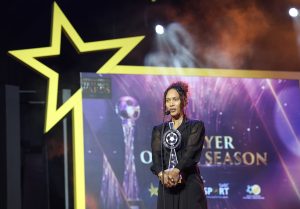


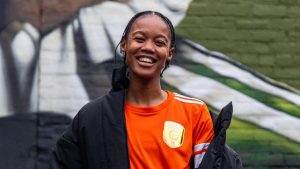




Whenever one wishes to get in touch with Shilene Booysen, she is en route somewhere – most likely at the airport, either leaving the country or returning home.
The former Banyana Banyana Performance Analyst has been crisscrossing the globe with one mission in mind: to make a powerful impact wherever she is and contribute to pushing the women’s game forward.
Looking back at her career, after cutting ties with the South African Senior Women’s National Team, the Capetonian moved to Houston Dash in the USA where she worked alongside Dutch native Vera Pauw, the former Banyana Banyana head coach.
Her star continued to shine and she was appointed to lead the South Sudan Women’s National Team where she spent two years.

Booysen then moved to North Africa to start a new project as the head coach of Wadi Degla in the Egyptian Women’s Premier League helping them compete in a cup final. During her time, she the club was able to produce national team players again after a long absence.
After leaving North Africa, Booysen has been working with both FIFA and CAF, acting as part of the Technical Study Group for the latter.
For the former, she is also a mentor in the FIFA Coach Mentorship Programme and also serves as a Technical Expert with a strong focus on coach education and high-performance development.

Just recently she made history by being part of the well-publicised Afghan’s Women’s Football story through the FIFA Unites: Women’s Series 2025. Initially, the event was scheduled to be staged in the United Arab Emirates but was moved to Berrechid in Morocco.
The event was a four-team tournament which featured the Afghan Women’s National Team, who called themselves Afghan Women United, alongside Chad, Tunisia and Libya.
“The work FIFA is doing through this series is absolutely vital for the global growth of the women’s game,” said Booysen.

The FIFA Unites – Women’s Series was part of FIFA’s drive to return the Afghan to the game after a long absence of not playing. The squad of 23 players was selected after three training camps in Australia and England.
Former Scottish international Pauline Hamill, was in charge of the team before stepping aside for a few days due to personal reasons, and Booysen took over the reins in the second match.
Although the team lost the game 4-0 against Tunisia (Wednesday, 29 October 2025), the South African saw a lot of improvement following their 6-1 defeat in the opening match vs Chad.
These games were an historic event as the Afghan women have not played as a national team since 2021 after the Taliban took over the running of the country.
And the tournament was part of the FIFA Strategy for Action for Afghan Women’s Football which was approved by the FIFA Council in May this year. The aim of the world football governing body on this project is to promote and protect the rights of all women and girls to play football while also contributing to the growth of the women’s game.

“I always say it’s just football, but this programme has shown me that it’s not just football. I am standing next to a group of players who have fought for themselves, who have fought for other women, who have fought for the country, who have fought to be on stage,” added Booysen.
FIFA President Gianni Infantino attended one of the matches where the squad played.
“This is the beginning of a beautiful, beautiful story that you are writing for yourselves, for your families, for so many girls and women all over the world. Thanks for being here, thanks for what you do. For me, it’s really a pleasure to see you all here and to be a little, little part of your team as well. I’m so proud of you,” Infantino told the players as he was presented with a signed jersey from the team.
The Afghan Women United squad is made up of players living outside their home country – with 14 residing in Australia, five in the UK and two each from Portugal and Italy.
“We are making history, and I am so grateful for FIFA for investing and trusting us, and believing in women’s empowerment, and really allowing us and giving us the platform to return to the pitch,” said Khalida Popal, a former Afghan footballer and women’s rights activist.
“It’s a young generation of Afghan women. They are standing with a great purpose, with a great mission, and that is to be the voice of Afghanistan, the voice of women from Afghanistan, but also they are inspiring people, not only women, around the world.”
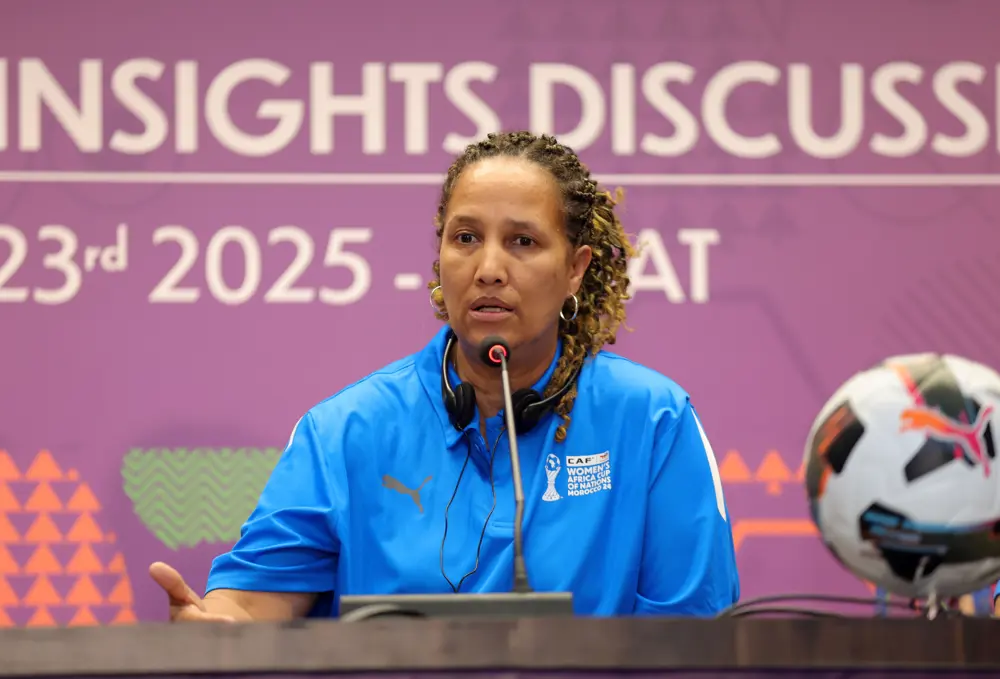
After the FIFA Series in Morocco, Booysen took up another assignment as a TSG member at the recently concluded CAF Women’s Champions League in Egypt.
But now her mission has taken her to another destination. She is currently in Monrovia, Liberia on FIFA duties where she is conducting a workshop for the Liberia Football Federation on Performance Analysis.
Before jetting off, Booysen spoke to CentreCircle.online about the Afghan project, her role at FIFA and also about the recently ended CAF Women’s Champions League.

What did it mean for you personally being on the bench for the Afghan Women United and being part of history – must have been something special?
HONESTLY, for me, being on the bench with Afghan Women United was one of the most profound and emotional moments of my career (and I have had many).
It went far beyond football it was about history, courage, and hope coming together on a single pitch. To stand beside players who have fought through unimaginable barriers just to play the game they love… that is a privilege I will carry for the rest of my life. It was special because it reminded me why I coach; to serve, to empower, and to help create opportunities where they have been denied. Seeing their pride, their resilience, and their belief grow with every minute on that field touched me deeply. This wasn’t just a match, and to be honest – the results did not matter, it was a moment that said to every (not just Afghan girl and woman watching) but every girl and woman in the world: your dreams are valid, your voice matters, and you belong in football.
Being part of this story humbled me, it strengthened me, and it definitely reaffirmed my purpose in this game.
Coming from a continent where women’s football is still lagging behind in some respects, how crucial is this initiative?
Coming from a continent where women’s football is still fighting for structure, resources, and recognition, the FIFA Unites series is absolutely crucial. For many countries, including across Africa, initiatives like this provide opportunities that simply do not exist at home: access to high-level competition, visibility, safety, and an environment where players can grow without fear or limitation. What makes the FIFA Unites series so important is that it goes beyond football. It creates platforms for women who have been marginalised, displaced, or restricted to step onto the world stage and express themselves through the game. It accelerates development, builds confidence, and gives federations and communities a blueprint of what is possible when investment is intentional. For those of us who come from regions still catching up in certain areas, this initiative is a reminder that progress doesn’t happen in isolation, it happens when global bodies use their influence to open doors, create pathways, and stand behind women’s football in a meaningful way.
I have realised that the FIFA Unites series is not just a competition; it’s a catalyst for growth, belonging, and transformation and the impact will be felt far beyond the tournament itself.

Looking at the aims of this series, how important is the work of FIFA in building the women’s game?
The work FIFA is doing through this series is absolutely vital for the global growth of the women’s game. When you look at the aims that are about creating opportunities, providing safe competitive environments, supporting displaced or under-represented groups, and accelerating development, you realise these are things many nations cannot achieve alone.
FIFA’s role is important because it bridges the gaps that exist between countries with established structures and those still building from the ground up. For teams like Afghan Women United, and even for many African nations, these opportunities are not just beneficial, they are transformative.
What FIFA is doing here is setting a standard that screams:
• Women deserve equal access to football.
• Women deserve platforms to compete.
• Women deserve to be seen and supported.
And when this comes from the world’s governing body, it carries weight. It creates momentum, encourages investment from federations, and shows young girls everywhere that the world is paying attention.
Ultimately, FIFA’s work in this space is not just about football development, it’s about empowerment, visibility, and rewriting the narrative for women who have historically been left behind.

How did you get involved with such an awesome project?
My involvement in this project happened quite organically, but it was rooted in years of work across women’s football and coach development. I heard about it and when I had a conversation with one of the leads on the project, my background in building programmes, supporting emerging nations, and working in environments where the women’s game is still growing or facing structural challenges opened up an opportunity. Over the years I’ve built relationships across the continent and globally through CAF, FIFA, and various clubs and national teams and those connections opened the door to this opportunity.
But honestly, what drew me in was the purpose behind the project. When I learned about the vision for Afghan Women United and the FIFA Unites series, providing safety, dignity, opportunity, and a platform for women who have been displaced or restricted, I knew it aligned deeply with who I am as a coach and as a human being.
So when the chance came to contribute, to help these players write a new chapter in their story, I didn’t hesitate.
For me, it wasn’t just an invitation to coach, it was an invitation to serve, to uplift, and to be part of something that truly matters and that has always been my motive.

The team played three games – despite the losses you saw signs of improvement?
Absolutely, the growth has been clear, even in the results not going our way. When you work with a team that has had limited opportunities to train and compete together, you judge progress by performance behaviours, not just scorelines. And in that respect, the improvement has been significant.
From the first game to the second, we saw:
- Better organisation and structure in and out of possession.
- More confidence to build play instead of playing under pressure.
- Improved communication and understanding between units.
- Greater bravery in 1v1 moments and defensive duels.
- More coordinated pressing and quicker reactions in transition.
These are the building blocks of a competitive team and they take time, repetition, and trust. The players are growing with every minute on the field, and most importantly, they are believing in themselves more. The results will definitely keep coming as the foundations strengthen, but the upward trajectory is already visible.
For a group that has overcome so much just to be here, their progress has been remarkable, and it’s only the beginning.

And what next for you?
My focus shifts back to the broader work I’m involved in within women’s football, both in Africa and internationally.I’ll continue my duties with CAF and the technical study groups, supporting coach education, performance analysis, and development programmes across the continent. At the same time, I remain committed to my role with Afghan Women United, helping them build a long-term structure that can support the players far beyond this tournament. Providing feedback and development and improvement documents that will help the individual players.
There are also a number of ongoing projects — workshops, coach development programmes, and team consultations that I will return to. For me, the goal is always the same: to contribute where I can make an impact and to keep pushing the women’s game forward.
So a tournament will end, the work continues with new environments, new challenges, but the same passion and purpose driving me.

Seeing four debutants in the CAF Women’s Champions League – what does it say about the growth of African football?
It’s incredibly exciting, and it speaks volumes about the direction African women’s football is heading. When you have four debutants in a competition of this level, it tells you that the game is expanding, investment is increasing, and more clubs are beginning to believe they can compete on the continental stage. What stands out for me as a member of the TSG is that these debutant teams are not just participating but they are competing, bringing their own identity, talent, and tactical ideas. It shows that development at club level across Africa is accelerating, and the gap between established teams and emerging ones is getting smaller every year. This growth is a result of improved coaching, better structures, stronger youth pathways, and more federations committing resources to the women’s game. You can feel the momentum. You can see the hunger. The presence of new teams is a sign that the women’s game in Africa is no longer confined to a few dominant countries, it is spreading, strengthening, and becoming truly continental and that is what we want to see. This is exactly what the CAF Women’s Champions League was created for: to inspire ambition, raise standards, and showcase the incredible depth of talent across Africa.

What did you make of the 2025 edition of the tournament?
For someone who has spent many years working in women’s football, what I have seen in this tournament is a true reflection of how far the African game has come but also how far it can still go. The CAF Women’s Champions League has quickly become a benchmark for performance, professionalism, and development on the continent for women’s club football, and each edition raises the standard a little more.
What I have just seen in Egypt includes:
- Higher tactical sophistication with teams showing clear identities, structured game models, and the ability to adapt to different opponents.
- Greater depth of talent not just standout individuals, but strong units and better team cohesion across all participating clubs.
- Improved physical conditioning and intensity is the kind of high-tempo football that mirrors global trends.
- Stronger match management and game intelligence and smarter decisions in key moments, better control of transitions, and more maturity under pressure.
- Competitive balance with new teams challenging established powers, reducing the gap and showing that growth is happening in multiple regions.
But beyond the technical aspects, what was great was the absolute confidence, joy, and belief from the players. Women across Africa are fighting for opportunities, visibility, and support and this tournament is a platform that empowers them. Ultimately, I hope this edition of the Champions League continues to push the game forward, inspire young girls across the continent, and remind us why investing in women’s football is not optional but has become truly essential. Because apart from the financial reward for participation, there was also an additional reward for the winner that will give them an opportunity to play off for a place the women’s Club world tournament in 2026. And this for African women’s football is huge and I love it for us.
By Matlhomola Morake
