







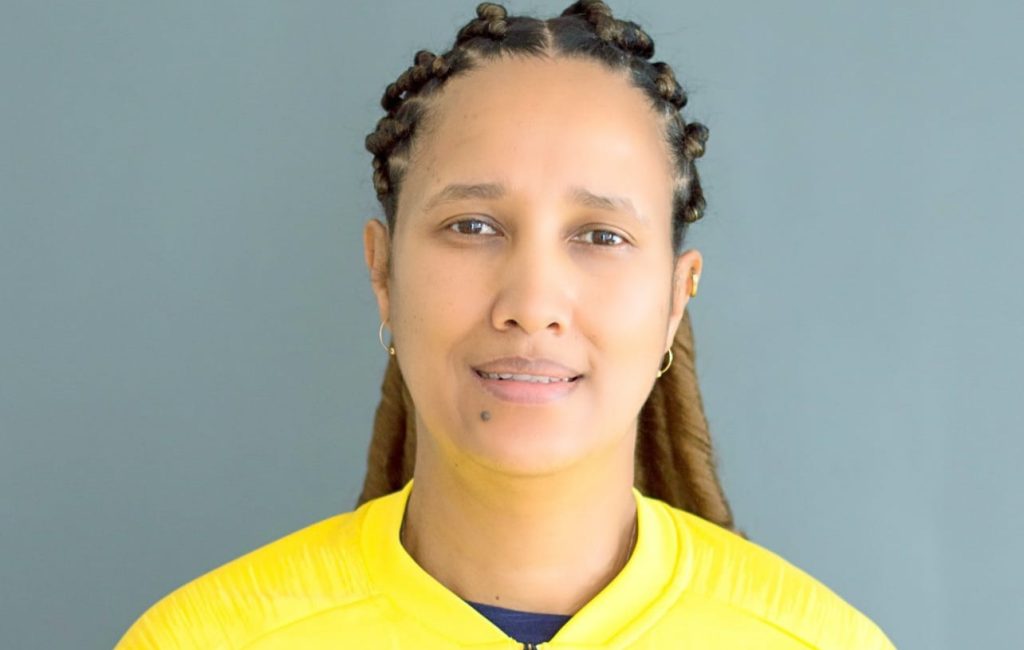
When the opportunity to lead the South Sudan Senior Women’s National Team as a head coach presented itself, Shilene Booysen didn’t think twice.
The former footballer, who was the Banyana Banyana Performance Analyst from 2014, has been toying around with the idea of being in charge of a team, so when the offer came she wasted no time.
She signed a two year contract with the Bright Starlets, who played their first international match only in 2019.
The Cape Town-born Booysen has also had a stint at Houston Dash in the USA where she worked alongside former Banyana Banyana head coach Vera Pauw.
She has also played for Westridge FC and Santos FC in Cape Town before signing for Spurs Women’s Football Club.
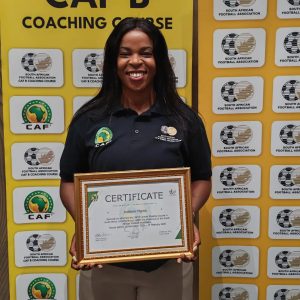
She holds a Football Level One Coaching Course qualification, as well as CAF B and CAF A licences. Booysen has also attended a Goalkeeper Coaching Course at the Farouk Abrahams Goalkeeper Academy.
She recently returned home for the Christmas break since her appointment in February. CentreCircle caught up with her before she went back to South Sudan.
CC: Coach Shilene you are back home for the festive break, welcome and it is good to have your back.
SB: Thank you so much. It is good to see family and friends again but with the high Covid-19 numbers, I might not be able to see as many I would like.
CC: First of all how would you describe your year?
SB: It has been a challenging year but also very rewarding.
 CC: You took a bold step to move to South Sudan – what led you to that decision?
SB: People always ask me “why South Sudan” and I always answer, why not South Sudan? It seemed like the perfect time for me to step out of my comfort zone where people just saw me as a performance analyst. It was a great opportunity for me to invest in African football and when I was looking at what they wanted to do with their women’s program, I felt it would be a perfect fit for both of us. I love to coach and teach, they want to grow so yes, a perfect fit. And of course, I prayed about it a lot before taking up the position.
CC: How was the transition first from South Africa to South Sudan?
SB: Culture shocking. In South Africa we have all the “luxuries” which seemed normal for us to have, things like electricity, running water, shopping malls, WIFI, etc. In South Sudan those are definitely luxuries and really expensive. However, God would never send me to a place He cannot protect me or where He doesn’t think I can make a difference. Like I said, it has been challenging but so rewarding on so many levels.

CC: Then from Performance Analyst to head coach?
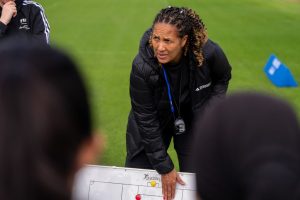
SB: I think people see me as a performance analyst first but I am a coach first and analysis is just one of the tools I have gained and perfected to add to my tool box. I have always been a coach and always knew I would go back to it. Not seeing me on the field does not mean I have not been coaching. There is however an adjustment that had to take place from being a person who supported the head coach to being the head coach who is now being supported. I loved the growth that I saw in myself but also the ability to teach and make sure others around me grow.
CC: You have also worked in the USA with Houston Dash, do you think that helped you when it came to moving to South Sudan.
SB: I think every coach that I have worked with in the past has contributed to where I find myself today. I have always worked “away” from home and that has helped when coming to South Sudan. Coaching in the USA does not compare to coaching here. The challenges are different, the infrastructure is different, the players are different. SSD is a relatively new country and so is the women’s football program. It helped of course that I had international experience when it came to competing with a relatively inexperienced team.
CC: It can be lonely out there all by yourself, how do you cope? The food, language? Being away from family, does that give you the extra motivation to work even harder?
SB: Honestly, I am one of those people who don’t get lonely very much or often. I love my own company and if I do miss my family or friends, it’s just a video call away these days. Food has never been a huge issue wherever I go because I am very adaptable, but it does
help that there is a shop here in SSD that sells many of the South African products. Everybody here understands English and I would say about 99% of the players speak it fluently. Of course the culture is different and I have to adapt as we try to change perceptions, but I think that is everywhere in the world. To be honest, I don’t think I know anything else but working hard. I have always been the provider for my family (close and extended) so I have an inborn desire to always do well and make sure everyone is taken care of. I love working with people and God has given me the opportunity to make a difference and that has been my extra motivation. It isn’t always easy and sometimes you think, is this really worth it….? But then you remember that you were born for such a time as this, and these players have hope and they are building a future for themselves and the next generations and I am a part of that.
CC: Any glaring defences between SA and where you are now?
SB: Seriously (lol), firstly SA has established leagues and SSD is just starting theirs. SA has 57+ million people, SSD has about 11 million. SA lives and operates like a first world country; SSD is definitely still a 3rd world country as they are in the building phase. SSD is much more expensive to live in than SA or even USA even though they are more underdeveloped than any of the countries I have been to on the African continent. I think one thing that is similar I find in the football environment is the challenges women’s football face to find their own spot in the sun. The struggle to get to the next level is always harder for women than men. Here there are many male academies and not many female versions thereof. We are hoping to change that. Culturally there is a very big difference.
CC: How would you describe women’s football in South Sudan?
SB: Developing. It’s going to take many years for women’s football to get to the level of the top nations in Africa but the federation is willing to support the drive and the development and that is why I have no doubt that it will grow to be a great women’s footballing nation. We are not short of talent but it is harder to develop the talent here than in most other countries in the world with extremely limited resources and of course the infrastructure challenges. We are making strides and that is what we need to develop the game. Even though it is small steps, it means we are moving.

CC: For the first time ever, South Sudan now appears on the FIFA Women’s World ranking list, that is quite a huge achievement. How did that happen?
SB: That has made me really proud as a coach and knowing how challenging the year has been, this was the reward that makes it almost all worthwhile. We always had a goal to get a FIFA ranking within the first two years of me starting as the coach here. We enquired as to what the criteria was to get onto the list and then we basically set up a playing schedule to meet those requirements. That was one of the main reasons we had opted to accept the invitation from COSAFA to play in their tournament. I think for us 2021 was not so much about winning or losing but about developing and I think we pretty much did that. 2022 is now be about winning and setting new standards.
CC: You have obviously been keeping tabs on the South Africa football space, what did you make of the 2021 season of the Hollywoodbets Super League?
SB: It was really interesting. Although it seemed like Mamelodi Sundowns ran away with the league again, the race for 2 and 3 positions were tough. Eventually it ended up with TUT ending second and UWC finishing third – that shows you the huge impact varsity sports also has on the women’s football arena in South Africa. Many of the other teams will have to make sure they step up if they want to achieve and not be relegated and I am sure that will be a huge motivation for teams to strengthen their programs and make sure they are competitive next season. It is going to be another huge year for women’s football in SA. It has taken many years to get here, but the next step has got to be a professional league. The players deserve it, the coaches deserve it and the whole women’s football community deserve it.
CC: How significant is the Sasol league, and would you encourage South Sudan to start something like that, if it is not there already?
SB: One of the biggest challenges is sponsorship, and mainly in the women’s game. We are looking to engage many sponsors this year and we now have a marketing strategy that will be of immense help to grow the game in SSD. Of course Sasol is the reason SA has reached so many milestones before and they will be part of the reason there will be many more. I cannot imagine where SA football would be without the huge investment by Sasol and the immense growth and opportunities we have seen over the years in women’s football. Our leagues will be run this year on a similar structure, teams playing in their different provinces/States and then a playoff tournament will determine the eventual national champion.
CC: Up to this point, what have been your highs and lows, if any?
SB: The lows have got to be that we have not yet won a game (hoping to change that soon). But the highs have been the fact that we got to play in the COSAFA 2021 tournament. Played our first friendly ever in the history of SSD women’s football, entered and played our first qualifying matches for the AWCON and then definitely getting a FIFA ranking.
CC: What’s the next challenge/target/mission for you and South Sudan in 2022?
SB: Our target will be to climb the FIFA ranking ladder of course, do better at CECAFA than before and the mission is to get 1 or 2 players into Europe to expose the talent that South Sudan has to offer. I have a feeling that 2022 will be a big year for South Sudan Women’s National team and cannot wait to start the 2022 program off with a bang.

CC: Lastly, you were a huge part of Banyana Banyana’s gradual rise, do you miss some of those moments, or is it a closed chapter to you?
SB: I do miss winning a lot (lol). I loved everything I achieved with Banyana Banyana, the coaches and other individuals I got to work with, but I have moved on. Now everything is about how to take the Bright Starlets to the next level. Coach Des and I still talk strategy many times for both our teams and in that way I guess I will always be a part of the setup. I talk to her at least 3-4 times a week (sometimes more). I ask for advice from her and she also asks for some from me. When I come up with something new especially in the analysis department, I share it with her and if she comes up with new ideas on how to deal with players, she shares it with me. We also talk about everyday stuff, family matters and when I get “lonely” she is one of the people I know I can call.
By Matlhomola Morake
